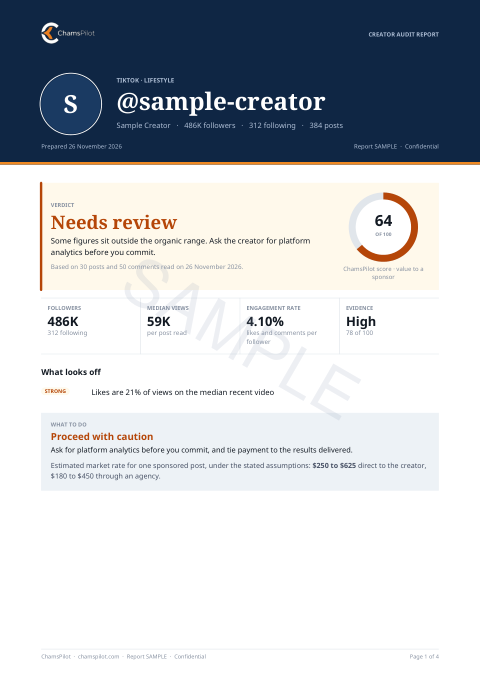
An influencer audit report tells a brand, before it pays a creator, whether the followers and engagement look real and what one sponsored post is worth. Below is a full sample of ChamsPilot's AI Deep Audit, written by the same code as every paid report, for a made-up TikTok creator. It opens with a plain verdict, a score and what to do, then one section each for the evidence, performance, audience, comments, pricing, sponsored posts, brand safety, and data and method.
ChamsPilot · Free Tools
Influencer Audit Report: A Full Sample
An influencer audit report tells a brand, before it pays a creator, whether the followers and engagement look real and what one sponsored post is worth. Below is a full sample of ChamsPilot's AI Deep Audit, written by the same code as every paid report, for a made-up TikTok creator. It opens with a plain verdict, a score and what to do, then one section each for the evidence, performance, audience, comments, pricing, sponsored posts, brand safety, and data and method.
The whole report, free to open
The PDF a buyer receives, for a creator who does not exist. Every page is stamped SAMPLE. No sign-up and no email needed.
What an influencer audit report includes, section by section
The cover: one plain answer: The verdict (Strong Candidate, Needs Review or High Risk) with one sentence on how strong the evidence is; a ChamsPilot score out of 100 for the creator's value to a sponsor; the key figures: followers, median views, engagement rate and how complete the evidence is; what looks off and, when it was measured, what looks real; what to do; and the fair rate for one sponsored post.
01 Evidence: Every figure is set against organic creators on the same platform, of the same size where size matters. Only the figures past the organic range are listed, strongest first, each with a mark showing how far past comparable creators it sits. This is where signs of bought followers, views, likes or comments show.
02 Performance: Average views, likes and comments, the engagement rate, how many followers a post reaches, the trend and the tone of the comments. Then the recent posts one by one, each with its likes per view.
03 Audience: Where the audience appears to be, by country, estimated from comment language, regional dialect and posting times. The report labels it an estimate, not the platform's own data, and shows the share with no signal as unattributed.
04 Comments: How many comments were read, a comment quality score out of 100 and how many comments the scan flagged. Each flagged comment is quoted with the reason, next to comments the scan did not flag.
05 Pricing: The fair rate for one sponsored post, paid to the creator directly and as the creator's share through an agency, set on the typical post with view spikes left out. Then what a sponsored post reaches, how many of the newest followers look like empty accounts when a follower sample was read, the price per format with its cost per 1,000 views, and how the price was worked out.
06 Sponsored posts and brand history: How many of the posts read were sponsored, the brands named in them, and how the sponsored posts did against the creator's other posts, in views and in likes and comments per view. Counted from paid-partnership labels, disclosure hashtags such as #ad, "sponsored by" wording and discount codes.
07 Brand safety: The creator's own captions read for adult content, violence, hate, drugs, alcohol or gambling, divisive politics and strong profanity. Every flag quotes the caption with its date. It is not part of the verdict.
08 Data and method: A confidence score out of 100 for how complete and stable the data is, what the report read, and how the verdict is reached. It states its limits: it reads public data as it was on the day, it describes patterns and does not prove anyone's intent, it is not legal advice, and commenters' names, languages and locations are never used as evidence.
How to read the verdict
The verdict compares what the report measured with organic creators of the same size. It is one of three, and the cover says what to do about it.
Strong Candidate: What was measured sits inside the range organic creators show, and nothing points to bought engagement. With a small sample it reads Strong Candidate, Review Recommended: confirm with the creator's platform analytics before a large deal.
Needs Review: Some figures sit outside the organic range. Ask the creator for platform analytics before you commit. Needs Review, Elevated Risk Signals means some figures sit well outside the range but the sample behind them is small.
High Risk: The combined evidence passes a line only a few organic creators in a hundred reach, from two independent findings or one decisive one. Treat the audience and its engagement as unverified until the creator shows platform analytics.
The score and the evidence level: The score out of 100 is the creator's value to a sponsor, a blend of reach, risk and evidence, not a second verdict. The evidence level (High, Medium or Low) says how complete and stable the data behind the report is.
What to do: Recommended, Proceed with caution or Not recommended, with one line on what to ask for or how to tie payment to results. It is chosen from the verdict and the data, not written by the AI.
What a sample is not
Not a real creator. @sample-creator does not exist, and every figure in the sample is made up to show what each section looks like. A real report reads the creator you name on the day you run it, and leaves out any section it has no data for.
A verdict on whether the followers and engagement look real, the key figures, the evidence measured against organic creators of the same size, the recent posts one by one, where the audience appears to be, a read of the comments, a fair rate for one sponsored post, past sponsored posts and the brands named, a brand safety read of the captions, and how the data was read. The sample on this page has every one of these sections.
Is the creator in the sample real?
No. @sample-creator does not exist and every figure in it is made up. The report around those figures is real: the same code writes every paid report, so the sample has the sections and the layout a buyer receives.
Can I use it as an influencer audit report template?
Yes, as a list of what to check and in what order: the verdict, the evidence against organic creators, the comments, the audience, the fair rate, past sponsored posts and brand safety. The figures behind each section come from reading the creator's posts, comments and followers, which is the work the report does for you.
How do I get this report for a real creator?
Run the free fake follower check on the creator's handle. The full AI Deep Audit is offered after the result, with its price for your country shown before you pay. You need no account: the report link comes by email.
Does the report prove the followers were bought?
No report can prove who bought what. It shows how far each figure sits from organic creators of the same size and says how strong that evidence is. Read Needs Review or High Risk as a reason to ask the creator for platform analytics before you pay, not as proof.
In which languages can I read the report?
English, French, Spanish, Arabic, and Simplified and Traditional Chinese. The report is written in the reader's language, and the sample opens in each one from the links under its cover.